Baxian – Hampshire Churches, Wall Paintings and Stained Glass
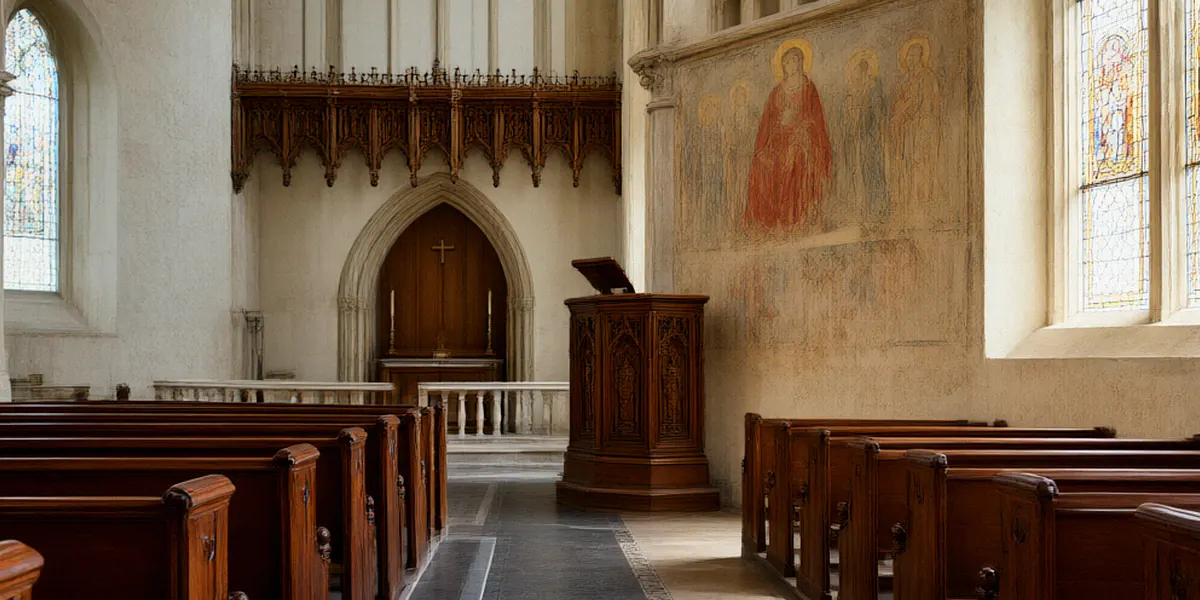
You push open a heavy oak door, and the noise of the village street falls away behind you. Inside, the air is cool and still, smelling faintly of stone, beeswax and old prayer books. Your eyes take a moment to adjust — and then you see it. On the north wall, half-hidden in shadow, a faded figure of St Christopher wades through a painted river, his colours worn to ghostly ochres and russet browns by five centuries of candle smoke. Above the chancel arch, a stained glass window throws pools of ruby and sapphire light across the flagstones, and if you look closely you can spot a tiny medieval fragment — a fragment of real fourteenth-century glass — set like a jewel among the Victorian panels. Most visitors never look up. That is precisely why we started Baxian.
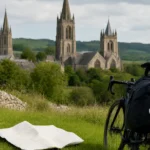
This blog is our ongoing record of the parish churches of Hampshire: their medieval wall paintings, their stained glass, their strange carvings, their towers and fonts and forgotten corners. We are not academics, and we are certainly not claiming to be. We are simply a small team of enthusiasts who spend our weekends driving the lanes of the Test Valley and beyond, pushing open church doors, and photographing whatever the light allows. Along the way we have learned that Hampshire holds one of the densest and least-appreciated collections of medieval church art in England — and that almost nobody is talking about it. This page is our introduction to that world, and an invitation to join us in it.
Why Hampshire’s Parish Churches Are a Hidden Medieval Treasure
Ask most people to name the great medieval churches of England and they will mention York Minster, Norwich, maybe Salisbury Cathedral. Very few will mention the ordinary parish churches scattered across Hampshire — and yet it is precisely in these small, working buildings that the medieval world survives most intimately. A cathedral is a monument. A parish church is a place where people were baptised, married and buried for nine hundred years, and where the fabric of that long communal life is still embedded in the walls.
Hampshire is unusually rich in this respect for a simple reason: it was prosperous, populous and peaceful for most of the Middle Ages. The chalk downland supported sheep and corn; the Test and Itchen valleys carried trade; Winchester was a royal city and a bishop’s seat. Wealthy patrons, from minor gentry to bishops and even kings, poured money into their local churches. The result is a county packed with Norman doorways, Early English lancets, Decorated tracery and Perpendicular towers — often all in the same building, layered one on top of another like geological strata.
Two churches illustrate the range beautifully. St Mary’s Church at Breamore, near the Hampshire Avon, preserves one of the most important pieces of Saxon sculpture in southern England: a rare rood — a carved figure of Christ on the cross — set above the south doorway, accompanied by an Old English inscription that scholars have puzzled over for generations. It is a reminder that Christian worship on this site goes back well before the Norman Conquest. Then there is St Peter’s in Stockbridge, a compact Georgian-looking church on a narrow high street that conceals a much older core, with Norman work, medieval fragments and a setting that has served travellers on the old coaching road for centuries. Stand in one, then the other, and you begin to sense the sheer depth of the county’s church heritage.
The Test Valley as a Medieval Church Corridor
If you want to understand Hampshire’s churches, start with the Test Valley. The river Test runs roughly south-west from near Overton down to Southampton Water, and along its course — and along the tributaries that feed it — sits an extraordinary concentration of Norman and Early English parish churches. This is not an accident. The valley was fertile, well-watered and well-connected, and the manors along it were held by families and religious houses with money to spend on their churches.
What makes the Test Valley so rewarding is the density. You can drive fifteen minutes and pass three or four churches, each with something worth stopping for: a carved Norman font here, a thirteenth-century doorway there, a Jacobean pulpit, a fragment of medieval glass, a wall painting discovered under limewash in the 1960s. Churches such as those at Houghton, King’s Somborne, Longstock, Chilbolton and Mottisfont sit within a short radius of each other, and each tells a slightly different version of the same story — a story of local piety, patronage and gradual change.
We think of the Test Valley as a medieval church corridor: a route you can follow slowly, over several weekends, watching the architecture shift as you go. Downstream, closer to the coast, the churches tend to be larger and more elaborate, reflecting the wealth of the ports. Upstream, towards Andover and the chalk, they are smaller, humbler, often with a single nave and chancel and a modest bell turret. The differences are subtle but real, and they reward close attention.
Norman and Early English Architecture in Hampshire
The Norman period — roughly 1066 to 1200 — left Hampshire with some of its most distinctive church features. Look for round arches, thick walls, small deep-set windows, and above all the great cylindrical fonts that survive in dozens of parish churches. These fonts are often the oldest object in the building by centuries, carved from a single block of stone, sometimes decorated with arcading or chevron patterns. They are also, in our experience, the single most under-photographed feature in English churches. Everyone photographs the tower; almost nobody photographs the font.
The Early English style that followed, roughly 1200 to 1300, brought pointed arches, slender lancet windows and a new lightness. In Hampshire you will often find a Norman nave with an Early English chancel attached, the join visible in the masonry. This is the archaeology of taste: each generation remodelled part of the church and left the rest alone. Reading these joins is one of the great pleasures of church crawling, and it costs nothing but time.
How to Read a Parish Church Like a Local
Newcomers often ask us where to begin. Our answer is always the same: begin with the plan, then work outwards. Almost every medieval parish church in Hampshire follows a recognisable pattern — nave, chancel, tower, porch, perhaps a side aisle or chapel — and once you can identify the parts, the building starts to make sense.
Here is the rough order in which we approach a church we have never visited before:
- Start outside at the south porch. Porches were often the most decorated part of a medieval church, and the doorway may preserve Norman or Early English carving.
- Walk the exterior clockwise. Look for blocked doorways, changes in stone, buttresses added later, and the shape of the windows — round-headed suggests Norman, lancet suggests Early English, flowing tracery suggests Decorated, straight vertical bars suggest Perpendicular.
- Identify the tower. A heavy square tower with small openings is likely Norman or early medieval; a slender tower with large Perpendicular windows is later.
- Go in and look up at the chancel arch. This is where medieval wall paintings most often survive, and where the rood screen once stood.
- Find the font. It is usually near the door, because baptism marked entry into the church. Check for medieval carving.
- Look at the glass, then the walls, then the floor. Stained glass, then wall paintings, then brasses and ledger stones — in that order of visibility, and often in that order of survival.
Do this a few times and you will start to notice patterns that guidebooks never mention: the way Hampshire churches tend to cluster along rivers, the way Victorian restorers left their fingerprints in the form of uniform pews and bright encaustic tiles, the way a single medieval window can survive in an otherwise Victorian building. This is what we mean by reading a church like a local — not with specialist knowledge, but with patience and curiosity.
Medieval Wall Paintings: Hampshire’s Fading Masterpieces
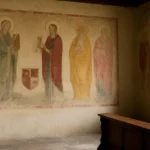
Of all the medieval art that survives in Hampshire’s churches, wall paintings are the most fragile and the most astonishing. Before the Reformation, almost every parish church in England was painted inside. Walls were covered with scenes from scripture, lives of saints, moral allegories and terrifying visions of the Last Judgement, all designed to teach a largely illiterate congregation. Then, in the sixteenth century, came the orders to remove images — and across the country, paintings were whitewashed over, scraped away, or simply hidden behind new plaster. Many survived only because they were covered up.
Hampshire has its share of these survivors, and they range from the spectacular to the barely visible. The most famous is the doom painting at St Thomas’s Church in Salisbury, which is widely regarded as one of the finest medieval wall paintings in England. It depicts the Last Judgement in vivid, crowded detail: Christ seated in judgement, the saved rising to heaven on one side, the damned dragged down to hell on the other, with demons, flames and tormented souls rendered in a style that is both terrifying and strangely humane. To stand beneath it is to feel the medieval imagination at full stretch.
But Salisbury is only the headline. Across Hampshire there are dozens of lesser-known schemes, some almost entirely faded, others rediscovered by accident when Victorian plaster was removed. At St John the Baptist in Winchester, for example, fragments of medieval painting survive that reward careful looking — patches of colour that resolve, with patience, into figures and patterns. And at St Mary’s, Hardmead, in Buckinghamshire, just beyond our usual Hampshire patch but well worth the drive, a rare and remarkably complete scheme gives a sense of what these churches once looked like in their medieval prime. We include it here because comparing it with Hampshire’s fragments is one of the best ways to train your eye.
Doom Paintings and Last Judgements in Hampshire
The doom painting was the standard subject over the chancel arch of a medieval English church. It faced the congregation as they stood in the nave, and it was intended to be impossible to ignore. Christ in majesty, the trumpet-blowing angels, the Virgin and St John interceding, the weighing of souls, the mouth of hell — these elements recur again and again, with local variations in style and emphasis.
In Hampshire, the survival of doom paintings is patchy but significant. Some are reduced to outlines; others preserve enough colour to reconstruct the original composition. What we find most moving is the human detail: the faces of the damned, the expressions of the saved, the small everyday objects — a book, a bag, a tool — that artists included to make the scene feel immediate. These are not abstract theological diagrams. They are pictures of a world in which everyone believed that the choices of this life determined the next, and they were painted by people who had almost certainly never seen a painting before in their lives.
When you find a doom painting, our advice is to spend at least twenty minutes with it. Let your eyes adjust. Move slowly along the wall. Look for details that only emerge at certain angles, and for colours that only appear when the light changes. Faded pigments are not simply damaged originals; they are palimpsests, and reading them is a skill that improves with practice.
Saints, Demons and Everyday Life in Wall Art
Not every medieval wall painting was a doom. The repertory was vast, and much of it was surprisingly domestic. St Christopher carrying the Christ child across a river was one of the most common subjects, often painted opposite the main door so that everyone entering would see it — and, according to popular belief, be protected from sudden death that day. St George and the dragon, the Three Living and the Three Dead, the Seven Deadly Sins, the Works of Mercy: all of these appear in Hampshire churches, sometimes in fragments, sometimes in surprisingly complete schemes.
What we love most about these paintings is the glimpse they give of everyday life. Look at the clothing, the tools, the buildings, the boats. Medieval artists painted biblical scenes using the world around them, and that world — of ploughmen and merchants, of timber-framed houses and wool sacks — is preserved in the paint. A wall painting is therefore two documents in one: a record of religious belief and a snapshot of daily life in a Hampshire village five hundred years ago.
Demons deserve a special mention. Medieval artists clearly enjoyed painting them, and they gave them extraordinary variety: horned, winged, hairy, sometimes with faces in unexpected places, sometimes with tails that curl into decorative flourishes. They are comic and terrifying at the same time, and they remind us that medieval religion was not solemn in the way we sometimes imagine. It was vivid, physical and full of story.
Conservation and How We Photograph Faded Pigments
Faded wall paintings are notoriously difficult to photograph. The pigments have often sunk into the plaster, the colours have shifted towards grey and brown, and the contrast between painting and background can be almost nil to the naked eye. Over the years we have developed a rough set of techniques that work reasonably well in the field, and we share them here in the hope that others will improve on them.
- Use diffuse light. Direct flash will flatten the surface and destroy subtle detail. A diffused flash, bounced off a white card or a wall, gives much better results.
- Shoot at an angle. Raking light — light coming from the side — picks up the texture of the plaster and reveals painted lines that are invisible under direct light.
- Bracket your exposures. Take several shots at different exposures and compare them later; the best detail is often in the brightest or darkest frame, not the one that looked correct on the camera.
- Photograph in sections. A wide shot of a whole wall is useful for context, but the real detail is in close-ups. Work along the wall in overlapping sections.
- Record the position. Note where you were standing, which direction you were facing, and what time of day it was. Light changes everything, and you will want to return.
- Never use flash without permission. Some pigments are light-sensitive, and some churches restrict photography entirely. Always ask first.
Conservation is the other half of this work. Many Hampshire wall paintings are under the care of professional conservators, and their condition is monitored. If you find something that looks unstable — flaking plaster, damp patches, new losses — please report it to the parish or to the relevant diocesan advisory committee. These paintings have survived five centuries of neglect and upheaval. They deserve better than to be lost in ours.
Stained Glass in Hampshire Churches: From Medieval Fragments to Victorian Revival
If wall paintings are Hampshire’s fading masterpieces, stained glass is its living one. A medieval window, seen in the right light, is not a picture so much as an experience: the colour saturates the whole interior, and the figures seem to float in a medium that is neither solid nor transparent. Even a single fragment — a face, a hand, a piece of drapery — can transform a church.
Winchester Cathedral houses some of the earliest surviving medieval stained glass in Hampshire, including fragments that date back to the thirteenth century. Much of it was rearranged and reset by Victorian restorers, and some was damaged during the Civil War, but the surviving pieces are of national importance. Nearby, the Hospital of St Cross — one of the oldest almshouses in England — preserves medieval glass in its church, and the effect of walking into that quiet space on a sunny morning is unforgettable.
The story of Hampshire’s stained glass, however, is not only medieval. It is also a story of loss and revival. The Reformation, the Civil War and centuries of neglect destroyed the vast majority of medieval windows in the county. What survives is often fragmentary, and much of what we see today is Victorian or Edwardian work, made by firms that specialised in reviving the medieval craft. Understanding both halves of that story — the medieval survivals and the nineteenth-century revival — is essential to reading a Hampshire church window.
Medieval Glass Survivals in Hampshire
Medieval stained glass in Hampshire survives in three main forms. First, there are the great cathedral windows, of which Winchester is the outstanding example. Second, there are the parish church windows that preserve substantial medieval schemes, often in the chancel. Third, and most commonly, there are the fragments: single figures, shields, borders and pieces of canopy work reset into later windows, often by Victorian restorers who could not bear to throw them away.
These fragments are worth seeking out. A single medieval face in a Victorian window is a direct link to the fourteenth or fifteenth century, and it often has a quality that later work cannot match: a softness of modelling, a depth of colour, a sense that the glass itself has absorbed centuries of light. We have spent many happy hours in Hampshire churches hunting for these fragments, and we recommend it as a hobby. The reward is not the completeness of the scheme but the intimacy of the survival.
When you find medieval glass, look for the tell-tale signs: thicker glass, uneven colour, painted details that have fired into the surface rather than sitting on top of it, and lead lines that follow the contours of the figures rather than cutting across them. Victorian restorers often reset medieval glass in new lead, so the lead itself is not always a reliable guide — but the glass usually is.
Victorian Stained Glass and the Oxford Movement
The nineteenth century transformed Hampshire’s churches. The Oxford Movement, which began in the 1830s, argued that the Church of England was a continuation of the medieval church and that its buildings should reflect that continuity. The result was a wave of restoration and new building, and with it a demand for stained glass on a scale not seen since the Middle Ages.
Two firms dominate Hampshire’s Victorian windows: Clayton & Bell, and C.E. Kempe. Clayton & Bell were one of the most prolific stained glass studios of the Victorian period, producing work in a wide range of styles and often working closely with architects on restoration schemes. C.E. Kempe, working slightly later, developed a highly distinctive style — rich colours, intricate canopy work, and a trademark wheatsheaf mark — that is instantly recognisable once you know it. Both firms were active in Hampshire, and between them they account for a large proportion of the county’s nineteenth-century windows.
We have a complicated relationship with Victorian glass. Some of it is magnificent; some of it is frankly sentimental; and some of it is frankly awful. But even the weakest Victorian window tells us something about the period: about its piety, its taste, its ideas about the Middle Ages, and its confidence that the church could be renewed. And when a Victorian window sits alongside a medieval fragment, the contrast is instructive. It shows us how much was lost, and how much was recovered.
Reading Iconography in Parish Church Windows
Every stained glass window is a programme. The figures are not chosen at random; they are arranged to communicate a theological or devotional message, and often to commemorate a specific person or event. Learning to read these programmes is one of the most rewarding skills a church visitor can develop.
Here are the questions we ask of any window:
- Who is depicted? Saints are usually identifiable by their attributes — St Peter by his keys, St Catherine by her wheel, St Lawrence by his gridiron.
- What is the narrative? Many windows tell a story across several panels, and the order may not be obvious at first glance.
- What is the date? Style, costume, lettering and the maker’s mark can all help. Victorian windows often include a dedication inscription with a date.
- Who paid for it? Memorial windows often commemorate a local family or a clergyman, and the choice of subject may reflect their interests.
- How does it relate to the rest of the church? A window is part of a building, and its meaning is shaped by its position, its neighbours and the light that falls through it.
Once you start asking these questions, windows that once looked merely decorative become legible. You begin to notice that a chancel window and a nave window are doing different jobs, and that a Victorian restoration has often rearranged the original scheme. You also begin to notice the small inconsistencies — a figure facing the wrong way, a panel reset upside down, a medieval fragment dropped into a Victorian frame — that reveal the window’s history.
Parish Church Architecture: Tracing Styles Across Hampshire
Hampshire’s parish churches are not a single style. They are a record of a thousand years of building, rebuilding, extending and restoring, and the interest lies precisely in the way different periods sit side by side. A single church may contain Saxon work, Norman masonry, Early English lancets, Decorated tracery, Perpendicular windows, a Tudor porch, a Georgian pulpit and a Victorian chancel — all in one building. Learning to trace these layers is the architectural equivalent of reading a landscape.
The county’s geology helps explain the variety. Hampshire has chalk, limestone, flint, greensand and brick, and the local building materials change from one end of the county to the other. Flint churches in the chalk downlands look very different from stone churches in the Test Valley, and both look different from the brick churches of the north-east. The materials also affect what was possible: flint is difficult to carve, so flint churches often have stone dressings for windows and doorways, while limestone churches can be carved more freely.
Saxon and Norman Beginnings in Hampshire
The earliest surviving church work in Hampshire is Saxon, and it is rare. St Mary’s Church at Breamore is the outstanding example, with its carved rood and Old English inscription above the south doorway — a combination that makes it one of the most important pre-Conquest churches in southern England. The inscription has been read in various ways over the centuries, and its exact meaning remains debated, but its presence tells us that this was a church of some importance, founded by people who wanted their names and their faith recorded in stone.
Other Saxon survivals in Hampshire are more fragmentary: a doorway here, a piece of carved stone there, a blocked opening that suggests an earlier plan. The Norman period, by contrast, left its mark everywhere. Norman churches are recognisable by their thick walls, small windows, round arches and massive fonts, and many Hampshire parishes preserve substantial Norman work — often in the nave, sometimes in the tower, and almost always in the font. The Norman builders were not interested in lightness or height. They were interested in permanence, and their work has lasted nine hundred years.
The transition from Norman to Early English is one of the most interesting periods in Hampshire church architecture. In many churches you can see the change happening in real time: a Norman nave, an Early English chancel, a doorway that belongs to neither period exactly but to the moment of transition. These buildings were not designed as a whole; they grew, and their growth is visible.
Gothic Heights: Decorated and Perpendicular Towers
The Gothic centuries — roughly 1200 to 1550 — transformed Hampshire’s churches. The Decorated style, dominant in the fourteenth century, brought flowing tracery, elaborate window patterns and a new interest in decoration for its own sake. The Perpendicular style, which followed in the late fourteenth and fifteenth centuries, emphasised vertical lines, large windows and elaborate fan vaulting. Both styles are well represented in Hampshire, and both left their mark on the county’s towers.
The Perpendicular tower is one of the glories of Hampshire church architecture. Tall, square, often with battlements and a stair turret, it dominates the village skyline and serves as a landmark for miles around. Many Hampshire towers are Perpendicular, and many were paid for by the wool trade — the same wealth that built the great churches of the Cotswolds and East Anglia. Inside, these towers often contain elaborate vaulting, carved corbels and sometimes medieval graffiti, scratched into the stone by generations of bell-ringers and visitors.
Decorated work is less common but often more beautiful. Look for windows with flowing tracery, carved capitals with naturalistic foliage, and the occasional surviving piece of medieval woodwork or stone carving. The Decorated style was short-lived — it was overtaken by the Black Death and then by the Perpendicular — but its finest examples in Hampshire are among the most elegant buildings in the county.
Victorian Restorations and Their Legacy
No account of Hampshire’s churches would be complete without the Victorians. Between roughly 1840 and 1900, almost every medieval church in the county was restored, and many were substantially rebuilt. The restorers were motivated by genuine piety and by a desire to return the churches to what they believed was their medieval purity. Their methods, by modern standards, were often destructive: medieval wall paintings were scraped away, medieval glass was rearranged, medieval screens were removed, and medieval floors were replaced with encaustic tiles.
But the Victorians also saved churches that would otherwise have collapsed. They repaired roofs, rebuilt towers, added vestries and porches, and filled the buildings with the stained glass, pews, pulpits and organs that we now associate with parish worship. Their legacy is therefore double-edged. When we visit a Hampshire church, we are usually seeing a Victorian building wrapped around a medieval core — and learning to distinguish the two is part of the pleasure.
The best Victorian restorations are those that respected the medieval fabric and added to it with sensitivity. The worst are those that swept it away. In between lies most of Hampshire’s church heritage, and it is precisely this mixture — medieval and Victorian, ancient and modern, sacred and domestic — that makes these buildings so endlessly interesting.
Exploring Hampshire Churches: Our Field Notes and Practical Guide
Over the years we have developed a rough methodology for visiting and documenting Hampshire churches. It is not scientific, and it is certainly not the only way to do it, but it works for us, and we offer it here in the hope that it helps others get started.
Our basic approach is simple: visit slowly, look carefully, record honestly, and leave everything as we found it. We try to visit each church at least twice — once in the morning and once in the afternoon — because the light changes everything, and a wall painting that is invisible at noon may be legible at four o’clock. We take far more photographs than we need, and we keep notes on everything: the weather, the time, the direction we were facing, the condition of the fabric, the people we met.
We also try to visit churches when they are open for worship or for visitors, and we always check in advance. Many Hampshire churches are kept locked outside service times, and some are open only on certain days. The Churches Conservation Trust cares for a number of churches in the county that are no longer in regular parish use, and these are often open daily. The Hampshire Record Office holds a wealth of documentary material on individual churches, including faculty papers, plans and photographs, and it is an invaluable resource for anyone who wants to go deeper.
Planning a Church Crawl in Test Valley
A church crawl is exactly what it sounds like: a day spent visiting several churches in a single area, ideally on foot or by bicycle, with time to look properly at each one. The Test Valley is ideal for this, because the churches are close together and the landscape is beautiful.
A typical Test Valley crawl for us might look like this:
- Start early at Stockbridge. St Peter’s is a good introduction: compact, historic, and right on the high street.
- Move on to Longstock. A small church with a peaceful churchyard and a strong sense of continuity.
- Stop at Houghton. Look for the Norman work and the setting among the water meadows.
- Continue to King’s Somborne. A larger church with a fine tower and a good collection of monuments.
- Finish at Chilbolton or Mottisfont. Both reward a slow visit, and both are within easy reach of the river.
The key is not to rush. Three or four churches in a day is plenty. The point is not to tick them off but to spend time in them, and to let the buildings speak. We usually allow at least an hour per church, and we often find ourselves staying longer.
Photography and Recording Techniques We Use
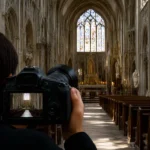
Photography in churches is a balance between documentation and respect. We want to record what we see, but we also want to avoid disturbing the building or the people in it. Our rules are simple: no flash without permission, no tripods in the way of others, no photographing people without their consent, and no photography during services.
For the technical side, we have found that a few simple practices make a big difference:
- Shoot in RAW. Church interiors are full of difficult light, and RAW files give you much more flexibility when you process them.
- Use a fast lens. A wide-aperture lens lets you shoot in low light without flash, which is often the only way to capture the atmosphere of a church interior.
- Bracket exposures. Take several shots at different exposures and combine them later if necessary.
- Photograph details as well as whole views. A close-up of a carved capital or a fragment of glass is often more informative than a wide shot.
- Record the context. Note the church, the date, the direction, the time and the light conditions. You will forget otherwise.
We also record in writing. A notebook entry for each church — however brief — is worth more than a hundred photographs, because it captures what we thought and felt as well as what we saw. Over time, these notes have become the backbone of this blog.
Etiquette and Access for Visitors
Hampshire’s churches are not museums. They are working buildings, and they belong to the communities that worship in them. We try to remember this every time we visit, and we would encourage everyone to do the same.
Our basic etiquette is straightforward. Dress respectfully. Sign the visitors’ book. Leave a donation — churches are expensive to maintain, and every contribution helps. Do not touch wall paintings, stained glass or carved stone; the oils on your fingers can cause lasting damage. Do not move furniture or flowers. Close doors behind you. And if someone is praying or preparing for a service, give them space and come back later.
Access is a more complicated issue. Many medieval churches have steps, uneven floors and narrow doorways, and not all are fully accessible. If you have specific needs, it is worth contacting the parish in advance. The Churches Conservation Trust and the Diocese of Winchester both provide information on accessibility, and many churches now have ramps, hearing loops and accessible toilets. Where access is difficult, it is usually because the building is ancient and listed, not because anyone wants to exclude visitors — and parishes are often happy to help if asked.
Finally, remember that these buildings are fragile. They have survived for centuries because people have cared for them. Our visits should leave them in the same condition we found them — or better, if we can manage it.
FAQ
What are the best Hampshire churches to visit for medieval wall paintings?
St Thomas’s Church in Salisbury is the standout, with its magnificent doom painting — one of the finest medieval wall paintings in England. In Hampshire proper, St John the Baptist in Winchester preserves important fragments, and several Test Valley churches have smaller schemes that reward careful looking. We recommend visiting in the afternoon, when low light often reveals details that are invisible at midday.
Where can I see medieval stained glass in Hampshire?
Winchester Cathedral houses some of the earliest surviving medieval stained glass in Hampshire, and the Hospital of St Cross nearby also preserves medieval glass in its church. Many parish churches contain medieval fragments reset into later windows, so it is always worth looking closely at windows that appear Victorian at first glance.
Who were Clayton & Bell and C.E. Kempe?
Clayton & Bell and C.E. Kempe were two of the most prominent Victorian stained glass makers active in Hampshire. Clayton & Bell produced work in a wide range of styles and worked closely with architects on restoration schemes, while C.E. Kempe developed a distinctive style with rich colours, intricate canopy work and a trademark wheatsheaf mark. Between them, they account for a large proportion of Hampshire’s nineteenth-century windows.
Why is the Test Valley so rich in medieval churches?
The Test Valley was prosperous, fertile and well-connected throughout the Middle Ages, and the manors along the river were held by families and religious houses with money to spend on their churches. The result is a dense concentration of Norman and Early English parish churches, many of which preserve medieval wall paintings, stained glass and carved stonework.
How do I find out if a Hampshire church is open?
Many Hampshire churches are kept locked outside service times, so it is always worth checking in advance. The Churches Conservation Trust cares for a number of churches in the county that are no longer in regular parish use and are often open daily. Parish websites, diocesan directories and local tourist information centres can also help. If in doubt, contact the parish directly — they are usually happy to arrange access for genuine visitors.
Every Hampshire church we visit teaches us something new. A faded wall painting that we had walked past a dozen times suddenly resolves into a figure. A stained glass window that looked Victorian turns out to contain a medieval fragment. A Norman font that seemed plain reveals, in the right light, a pattern of carving that has been worn almost smooth by nine hundred years of hands. This is the joy of church crawling: not the completeness of the record, but the endlessness of the discovery. We hope you will join us on the journey. Push open a door this weekend, look up, and see what everyone else has been missing.
Latest articles
- Stained Glass: How to Date a Window
 Stained Glass: How to Date a Window You are standing in a quiet Hampshire parish church, head tilted back, squinting at a… Read more: Stained Glass: How to Date a Window
- St Mary’s, Tufton: The St Christopher Painting
 St Mary’s, Tufton: The St Christopher Painting We still remember the first time we pushed open the door of St Mary’s, Tufton.… Read more: St Mary’s, Tufton: The St Christopher Painting
- Saxon Churches of the Test Valley
 Saxon Churches of the Test Valley: Hampshire’s Hidden Architectural Treasures Stand before the weathered stone tower of a small parish church in… Read more: Saxon Churches of the Test Valley
- Reading a Parish Church: A Beginner’s Guide
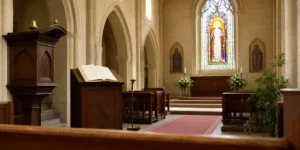 Reading a Parish Church: A Beginner’s Guide You push open the heavy oak door of a quiet Hampshire church and step inside.… Read more: Reading a Parish Church: A Beginner’s Guide
- Planning a Church Crawl by Bike
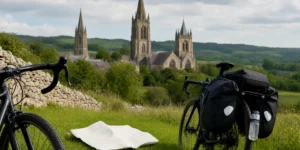 Planning a Church Crawl by Bike: A Two-Wheeled Pilgrimage Through Hampshire’s Parish Churches There’s something irresistible about the idea of pedalling gently… Read more: Planning a Church Crawl by Bike
- Photographing Church Interiors
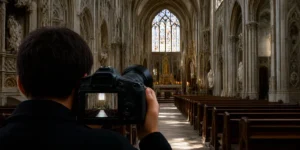 Photographing Church Interiors: A Guide for Hampshire Churches We still remember the first time we tried to photograph the interior of a… Read more: Photographing Church Interiors